
What if the most common wallet risk isn’t a hacker breaking into your device, but you approving a transaction you don’t actually understand? That’s the framing Rabby Wallet uses to justify transaction simulation inside a browser extension: simulate what a smart contract call will do to your balances and fees before you hit “confirm.” For DeFi power users who route complex swaps, participate in liquidity mining across chains, or delegate approvals to automated services, that claim deserves close scrutiny. Transaction simulation changes the decision point from “trust the UI” to “inspect a predicted outcome,” but it also has technical limits and operational trade-offs that are easy to miss.
In this article I unpack how Rabby’s simulation works at a mechanism level, why the feature matters in practical U.S. DeFi use cases, where it reduces risk materially, and where it can’t substitute for broader security hygiene. I demonstrate the most common misconceptions I encounter among advanced users and offer a short decision framework you can reuse when choosing a multi-chain extension wallet.
How transaction simulation works (mechanism, not marketing)
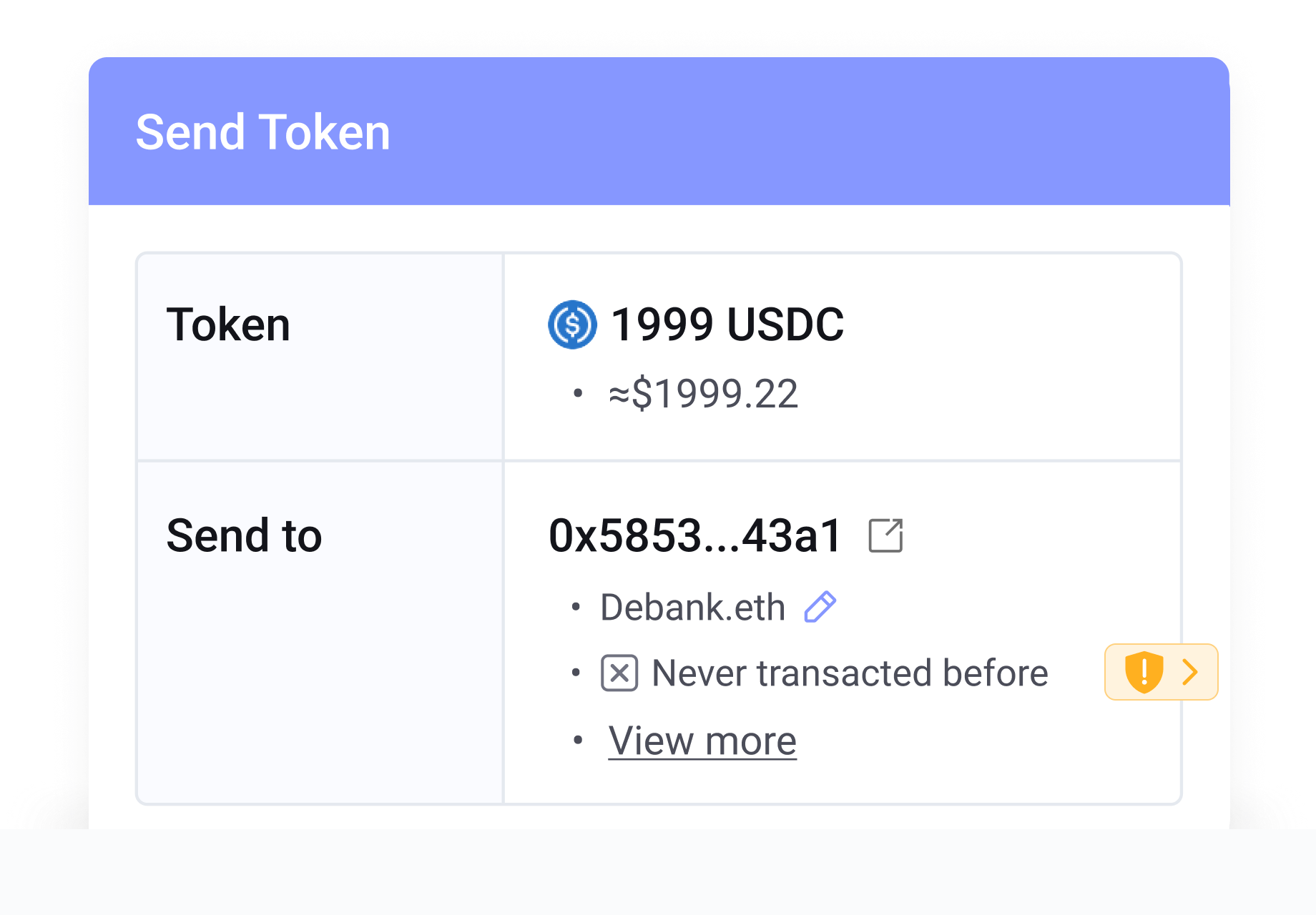
At its core transaction simulation is what researchers call forward-state estimation: given the transaction data (the target contract address, calldata, value, gas parameters) and a recent blockchain state, run the transaction in a deterministic EVM (Ethereum Virtual Machine) environment and compute the post-execution state without broadcasting the transaction. Practically, Rabby takes the signed or pre-signed payload the dApp intends to send, runs it against a node or an in-extension emulator, and returns a compact report: estimated token balance changes, ERC‑20 transfer effects, gas cost estimates, and named risk flags (e.g., “contract previously exploited,” “approval to unlimited amount”).
This is mechanistically different from heuristic UI warnings. It attempts to show the exact delta — not just that “this looks risky” — and that precision is what prevents blind signing: you can see the token amounts that will leave your account and the fee you will pay before you permit the signature that executes the transaction. That said, the simulation depends on two factual inputs: an accurate recent chain state and faithful emulation of the contract’s code path. If either is stale or incomplete, the result is only an approximation.
Why this matters for DeFi power users in the U.S.
In U.S. DeFi workflows, several behaviors make simulation valuable. First, cross-protocol transactions — aggregators, multi-hop swaps, batch transactions via routers — often bundle many state changes in a single call; a single “Approve + Swap” flow can do approvals, transfers, and nested contract calls. Humans rarely read nested calldata; simulation turns that unreadable blob into numbers you can assess. Second, automatic network switching and multi-chain activity increase accidental risk: signing on the wrong chain can create irreversible losses if you approve a malicious contract on a low-liquidity testnet or send assets to a non-existent recipient on a less familiar chain. Rabby’s automatic network switching plus simulation reduces the human error vector by aligning the chain context and exposing the numeric outcome.
Finally, institutional and multi-sig users benefit two ways: Rabby integrates with multi-sig and custody tools such as Gnosis Safe and enterprise providers (Fireblocks, Amber, Cobo), and simulation offers each signer a clear, independently verifiable summary of consequences before co-signing. That matters for governance and audit trails when signers must confirm compliance with internal rules.
Common misconceptions — and the corrections you need
Misconception 1: Simulation guarantees safety. Correction: Simulation reduces information asymmetry but does not eliminate all risks. It cannot protect you against a contract whose post-state depends on off-chain triggers, relayer behavior, or time-sensitive oracle manipulations that change between simulation and broadcast. Simulation is a snapshot based on current or near-current on-chain state; rapidly changing conditions (front-running, MEV sandwiching, mempool reordering) can change the actual on-chain outcome.
Misconception 2: Simulation reveals hidden malicious logic. Correction: Simulation shows state deltas but does not prove the intent behind code. A contract could transfer an unexpected token to a third party in ways that show in balances but are harder to interpret (e.g., re-entrancy patterns). Similarly, a contract that later changes behavior through upgradeable proxies could allow a safe-looking simulation today and a malicious result tomorrow. The simulation complements — but does not replace — code audits, source verification, and approval management.
Misconception 3: You can trust any simulation report. Correction: The trust boundary includes the node or emulator used for simulation and the extension’s open-source implementation. Rabby is open-source under MIT, which enables independent auditing; however, users must still trust that the extension talks to a reliable node and that the simulation engine models the EVM features (precompiles, gas metering, and reverts) accurately. Third-party audits and transparency about simulation backends increase confidence, but do not remove the dependence entirely.
Where Rabby demonstrably reduces real-world attack surface
Against common threats — blind signing, accidental approvals, and sloppy multi-chain context — Rabby’s features combine to materially reduce risk. The pre-transaction risk scanning flags previously hacked contracts and suspicious approvals; the approval revocation tool lets you cancel unlimited allowances; hardware wallet compatibility lets high-value accounts keep private keys offline; and the cross-chain gas top-up solves a practical U.S. user problem when interacting with L2s or alternative EVM chains that require native gas tokens.
Because Rabby aggregates portfolio data from over 90 EVM chains, power users can also spot cross-chain leakages or unexpected token movements faster than in single-chain wallets. Those operational improvements are not theoretical: they address the common incident pattern where users repeatedly approve unlimited allowances to DEX routers and never revoke them.
Where it still breaks or has blind spots
First, simulation cannot prevent social-engineering attacks where a user is persuaded to reveal seed phrases, approve transactions while under coercion, or use a malicious hardware wallet companion app. Second, on-chain simulation cannot predict or prevent economic attacks that rely on market movement between simulation and settlement — for example, a swap that looks fair in the simulation but is front-run on-chain. Third, Rabby currently lacks a built-in fiat on-ramp and native staking: if your workflow depends on buying crypto with a U.S. bank debit or on delegating/unstaking inside the wallet, you will need third-party services, which reintroduce custody and compliance trade-offs.
Last, historical incidents matter. A 2022 Rabby Swap smart contract exploit costing roughly $190,000 shows that even projects focused on security can be exposed via a combination of contract design and operational issues. The team froze the contract, compensated users, and increased audits — a responsible response — but it also underlines that simulation alone does not immunize a product from design-level vulnerabilities in smart contracts it interfaces with. For institutional risk models, that means maintaining insurance, multi-sig controls, and on-chain monitoring in addition to simulation.
Practical heuristics for DeFi power users: an action checklist
Use this checklist every time you route a nontrivial transaction:
1) Read the simulation’s delta, not the label. Confirm the exact token amounts moving and the net balance changes for each asset. If the simulation shows transfers you don’t recognize, pause.
2) Verify the node context. Ensure the extension is simulating against a reliable, up-to-date node or your own archive node if you run one. Stale state increases the risk of incorrect simulations.
3) Keep approvals granular. Use Rabby’s approval revocation and avoid unlimited allowances unless automation requires them and is auditable.
4) Combine hardware keys for high-value accounts. Rabby’s Ledger/Trezor/Keystone etc. support lets you keep signing keys off the host while still benefiting from in-extension simulation.
5) Treat simulation as necessary but not sufficient. Continue to use multi-sig for institutional funds, monitor contracts you interact with for upgrades, and ensure you have post-incident playbooks (revoke approvals, notify counterparties).
Decision framework: when to prefer Rabby (and when not)
Pick Rabby if you: often execute complex multi-hop swaps, manage assets across many EVM chains, need native approval controls, or participate in institutional signing workflows that benefit from clearly visible simulation outputs. The automatic network switching and built-in risk flags are particularly helpful when you move between Arbitrum, Optimism, Polygon, and smaller EVM chains frequently.
Consider alternatives if you: require integrated fiat rails and in-wallet staking, are locked into an exchange custodial flow, or your team demands a wallet with a different trust model (for instance, entirely hardware-only UX without a rich extension). Rabby competes well with MetaMask, Trust Wallet, and Coinbase Wallet by adding simulation and approvals, but those alternatives may have different user experience trade-offs or richer fiat integrations.
For a practical starting point, install the extension, link a read-only account or a hardware wallet, and replay past transactions through Rabby’s simulation to calibrate expectations — you’ll quickly see when the simulation catches oddities you previously missed.
What to watch next (signals, not predictions)
Three signals will determine whether simulation becomes a standard expectation for DeFi wallets: (1) integration of reliable mempool modeling to account for MEV risks between simulation and settlement; (2) wider adoption of standardized machine-readable warnings so third-party tools can verify simulation reports; and (3) continued transparency about simulation backends and audits. If Rabby and peers expand into those areas, simulation will shift from a protective convenience to an operational necessity for professional users. If not, simulation remains a powerful but bounded safety layer.
For now, Rabby’s recent positioning as “go-to wallet for Ethereum and EVM” underscores the product-market fit among users who prioritize on-chain clarity and multi-chain operations. The best use of simulation is not complacency; it is to raise the baseline of what it means to consent to a transaction.
To evaluate the extension yourself and see the UI in action, start from the project page for the browser extension and follow secure setup steps for hardware wallets and approval management. One convenient entry is the project’s info page on cryptowallet resources: rabby wallet.
FAQ
Does Rabby’s transaction simulation prevent all kinds of sandwich or front-running attacks?
No. Simulation shows the expected state change given current on-chain conditions, but it cannot control mempool ordering or prevent miners/validators and bots from reordering or front-running transactions after submission. Simulation helps you notice suspicious value transfers and incorrect approvals before signing, but to mitigate MEV you need additional strategies like private relays, transaction batching, or frontrunning-resistant relayers.
Can I rely on Rabby’s security flags to know whether a contract is safe?
Security flags are useful heuristics — they highlight contracts with known incidents, suspicious approval patterns, or non-existent recipients — but they are not formal proofs. A flagged contract may be safe, and an unflagged contract may be exploitable due to zero-day vulnerabilities or on-chain upgrade paths. Treat flags as prompts for further review, not as binary judgments.
Is it safer to run Rabby as a browser extension or a desktop/mobile client?
Each platform has trade-offs. Extensions are convenient for rapid dApp interaction and benefit from Rabby’s automatic network switching and simulation integration, but they share the browser risk surface (malicious extensions, phishing pages). Desktop and mobile clients reduce exposure to browser extension attacks but may be less integrated with some web dApps. Using hardware wallets in combination with any client gives the strongest key security.
How should institutional teams integrate simulation into signing policies?
Use simulation as an evidence artifact in the signing workflow: require a simulation report attached to any multi-sig transaction, have signers independently verify deltas against expected outcomes, and keep logs of simulation snapshots for post-incident audits. Combine this with off-chain controls like predefined approval limits and role separation so simulation augments governance, rather than being the sole safeguard.